Prediction Laboratory
Yuz Museum, Shanghai
November 19, 2016- March 5, 2017
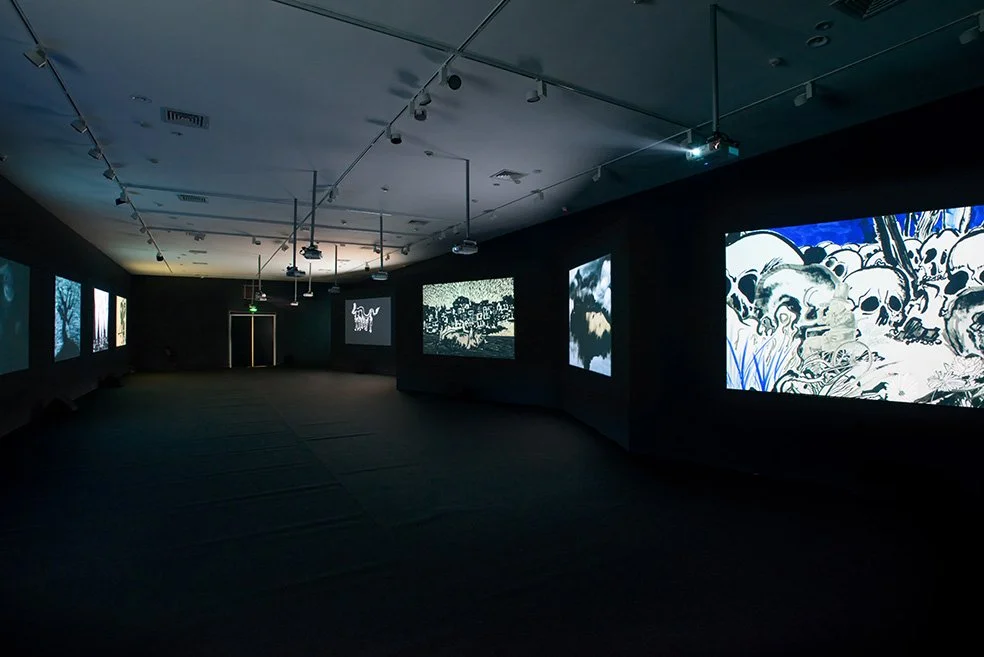
A Tunnel of Films
In this way, Prediction Laboratory is a perfect summation of this achievement and the first opportunity for an audience to get an overall view of what Sun Xun has been aiming at for the course of his career. Having already completed 18 films, with several new ones in the works for exhibitions in late-2016, Sun Xun has chosen to share twelve animations on this occasion. Ranging from Utopia in a Day (2004) which he made while still a student to the more recent What Happened in Past Dragon Year (2014), these films convey the artist’s major themes and imagery while working in a wide variety of mediums. More importantly, by simultaneously projecting them all on opposite walls in the same room, he magnifies their power and takes us one step closer in understanding their true meaning. While each is powerful in its own right, taken together they become a true Gesamtkunstwerk, German composer Richard Wagner’s phrase for a “total work of art” capable of encompassing all of the senses.
For this exhibition, the films are organized in chronological order with one wall covering the period of 2004 to 2008 and the opposite displaying works from 2008 to 2014. This might lead one to presume that these artworks have evolved in a linear fashion. Nothing could be farther from the truth. An early work such as Lie (2006) displays a blend of vintage newsreel and animation as sophisticated in its conception as any of Sun Xun’s later works. The accomplishment of his 27-minute film, 21 Grams (2010), is only magnified by the fact that it pulls together so many of the themes and images tested out in earlier films. All of the works benefit from being shown in the company of the others. A progression implies a need for improvement, which is not necessary even in the case of Sun Xun’s first works that are truly completely accomplished just the way they are.
Sun Xun’s first film, not included in the exhibition, was Tooth Extraction (2001) based on a short story by Alfred Hitchcock. It is telling that this Chinese artist as a young student took inspiration from the master of suspense. Many of the animations maintain an atmosphere of suspense, even though they have no plot or linear narrative. These are surrealistic works with the logic of dream states where one scene jumps to an entirely different location and characters change form seamlessly. Utopia in A Day (2004), the earliest work in this exhibition, depicts a policeman as a puppet controlled by a giant-sized skeleton interspersed with live action scenes of bottles exploding. A ringing alarm clock becomes a tank becomes a praying mantis becomes a dragon fly until all of this turns into a war. It is a nightmare of a conflict rather than the promised utopian dream.
This animation already displays many of Sun Xun’s dominant concerns which come to the fore in his next work, Lie (2006). Taking off from newsreel of China’s first atomic blast, the title comes up stating “Lie” just as we hear the anticipated explosion. This work introduces his favorite character--the magician--“the only legal liar” according to the artist. The magician enlarges a mosquito until its big enough to ride. They scale a plinth, like the one found in Tiananmen Square, and pose atop it like a heroic figure on a horse. Just then, Sun Xun switches back to the A bomb explosion, showing the crowds, dressed in Mao suits, cheering at their success. While pointed in its political criticism, the work is far from didactic because the drawings are so mesmerizing.
Mythos (2006) elucidates many of the meanings buried in Sun Xun’s works and has a bright color palette. The magician, a crow, fuming smokestacks, cloudy skies: these are images that are repeated frequently in the animations. The magician watches as volcanoes explode and delivers speeches rather than performing tricks. In this work, the magician is clearly a stand-in for a politician, distracting crowds with his sleight of hand. Just when it appears that the film is over, the artist presents a glossary of terms--“Geocentric theory,” “Magic,” “History,” “Country,” “Historical Materialism,” “Historical Idealism,” “Revolution” and “Mosquito”—with definitions heavily indebted to Marx and Engels. Read carefully, the words make clear that Sun Xun would like to use the relatively harmless medium of animation not just to take down particular politicians or regimes but to deconstruct history itself.
It is in Mythos that Sun Xun first defines the magician as “the only legal liar,” a phrase he has repeated frequently in interviews. He is fascinated by the way people know a magician is performing tricks and know they are being fooled, yet they voluntarily submit themselves to the experience. People universally condemn lying, yet they pay money to see a magician, they watch mesmerized by his swift movements and they are surprised and thrilled by the results. Even though they know this is a performance, the audience believes in the magic and falls under the magician’s powers. If the magician is an allegory for political leaders, as it seems to be the case in Sun Xun’s animations, the emphasis is not on the persuasiveness of the performer, but on the complicity of the audience without which the magic (or the oppression) would not be possible.
The magician returns in Sun Xun’s highly creative animation Shock of Time (2006), the first film created by π Animation, just after the artist founded the company a year after graduating China Academy of Art. This work was assembled much like a flip book with the artist drawing frame after frame on individual sheets of newspapers, dating from the Cultural Revolution. He then filmed each page which when strung together in rapid succession fool the eye into believing the drawings are moving. Across the headlines, we see a headless magician performing tricks and waving his cape, obfuscating our view of the news as he entertains us. In this way, the legal liar demonstrates that the words written in newspapers are lies. He skillfully uses the artifice of ink to underscore a truth about a moment in Chinese history when news came from a single source and was highly controlled by the government. Sun Xun is obviously making a point that is as relevant today as it was forty years ago. But again, he does this in a manner that is so highly entertaining in and of itself that it probably will escape the censor’s understanding.
In several subsequent films, Sun Xun refines his depictions of the magician, employing different mediums with each animation. In Requiem (2007), the magician is Charlie Chaplin, as Sun Xun inserts footage from a silent film into a drawing of a television set. It is in this animation that the artist first displays the logo of the mosquito on top of a globe bearing the map of China, putting it on a flag and the side of a train. In Heroes No Longer (2008), a newspaper account of the Soviet launch of a satellite into space is overrun by the image of a magician peering through the telescope, as the action is interspersed with Marxist quotes about “class consciousness” and “proletarian politics”. Films not included in this exhibition that also recycle the image of the magician include Magician’s Lie (2005) in which Sun Xun uses his own body as rudimentary drawings come alive across his chest; and Magician Party and Dead Crow (2013), a 3-d film created during the course of a 2 month residency at Shanghart Gallery in Beijing.
None of these films provide easy storylines or morals. Instead, Sun Xun appears to be rejecting even the notion of narration, ever wary that any account of history bears evidence of official influence. His concern is not simply political persuasion and government intervention. He is also looking at the evolution of historical accounts, from the Dynastic era to contemporary text books, noticing the ways that our methods of recounting history have developed over time. Unlike many artists of his generation, he does not adopt a stance of amnesia or an apathy towards the facts. Instead, he searches for “alternative narratives,” as once stated by Hou Hanru in describing Sun Xun’s work. The alternative he finds is not just a variation on official accounts of political history. It injects doubts into the very notion of objectivity.
Variety of Styles
Over the years, Sun Xun has developed a personal vocabulary but has veered away from evoking a distinct visual style. His technique changes from animation to animation—charcoal sketches, pastel drawings, ink brush painting, woodcuts--allowing him to test the limits of his craft. He retains the handmade look to his films, never letting the computer takeover the image-making. Yet, the “Sun Xun Sensibility” comes through even in films that do not rely on his usual cast of characters. Coal Spell (2008), for example, presents a meditation on the very real problem in China, namely, the pollution and overproduction of its coal plants. This is a personal work reflecting in detail scenes Sun Xun must have witnessed as a child in Fuxin. Or in the People’s Republic of Zoo (2009), Sun Xun takes inspiration from George Orwell’s Animal Farm to make creatures imitate human behavior and power struggles including a pig in a top hat riding a globe.
This meditation on history culminates in Sun Xun’s monumental animation, 21 Grams (2010). This film, which runs 27-minutes long, is made from over 30,000 pastel realist drawings depicting 50 scenes in a dystopian landscape. Four years in the making, it was the first work of animation from China included in the Venice International Film Festival. In this film, Sun Xun places the magician in a town filled with Colonialist architecture, early 20th century technology and WWI flying dirigibles. With ominous music and threatening skies, he establishes a critique of western capitalist conventions, underscoring his pessimistic view of all political systems.
The title, 21 Grams, is inspired by the research conducted by one American physician, Dr. Duncan MacDougall, in 1907, who claimed to have discovered the weight of the human soul, an experiment that encapsulates the positivist thinking resulting from the capitalist compulsion to quantify and commodify even that thing which is impossible to measure. In 21 Grams, Sun Xun presents a world where the spiritual has been replaced by demonstrations and monuments, ending with the sorrowful image of a lighthouse beaming out the word “revolution” in Morse code as a lonely man faces the ocean and cries.
For artists of Sun Xun’s generation, the primary historical fact they must face is the post-revolutionary transformation of their homeland over the past 40 years. Missing out on the misguided idealism of the Cultural Revolution (1966-1976), they must find meaning in a world overrun by capitalist brands. Sun Xun, however, goes farther than any of his peers in evaluating and capturing the psychological mindset induced by this state of affairs. The world he presents in 21 Grams is not only post-Mao, but also post-Marxist, post-Cold War, post-science and post-religion. It is a imaginary country filled with plagues of mosquitos, spewing smokestacks and crowds of magicians.
Some Actions Which Haven’t Been Defined Yet In The Revolution (2011) transforms a mundane day in the life of an ordinary student into a nightmarish screen play. Most remarkably, rather than drawing in charcoal or ink, Sun Xun creates this amazing work using thousands of woodcuts created by a team of carvers. The main character wakes to a raging alarm clock, picks an insect from his teeth and swallows it and passes the time in a boring lecture hall by vigorously masturbating. Just these actions alone would be difficult to achieve in the laborious manner of woodcuts, an ancient Chinese technique that was revived to create propaganda posters during the Cultural Revolution. Here, Sun Xun’s revolution is personal and psychological, underscored by a deeply disturbing musical score. But just when you might think that this work has nothing to do with politics, Sun Xun ends his character’s day by detonating a bomb, allowing an outside explosion to disrupt his malaise and disillusionment.
To create the animation Beyond-ism (2010), Sun Xun masterfully employed traditional ink-and-brush painting during a residency in Yokohama, Japan. Inspired by the tale of the first Chinese emperor Qin Shihuang who reportedly sent a court sorcerer Xu Fu with 3,000 girls and boys to sea to find the secret of life, Sun Xun goes well beyond illustrating the account. According to the story, the children never returned and are believed to be the original inhabitants of Japan. Sun Xun streams together images of elephants playing in waves, a peacock riding on a train and bats swooping through the sky. Repeatedly we see the image of ants crawling over calligraphy—a poem by Chairman Mao—with words so romantic and beautiful that they transcend politics.
When Sun Xun chooses ink-and-brush painting, he does not want to evoke a nostalgia for classical traditions or to glorify the past. He often does this to create a juxtaposition between art techniques of the past with present day conditions and future concerns. In his latest ink inspired animation, titled What Happened in Past Dragon Year (2014), he startles viewers with a series of quotes from Nikolas Tesla and Leon Trotsky, Aldous Huxley and Franz Kafka, posing a sharp and distinctly western introduction to a film riddled with Chinese allusions. Two dragons in chains wrestle with each other in a sky filled with red clouds, rendered as in a classical scroll painting. But the animation does not remain traditional for long. After an appearance by the magician, now an old man in a wheelchair, the action shifts to a concert hall. The orchestra strains to play a symphony while the ungrateful audience objects, hurtling chickens, ducks and roosters at the stage. The final scenes include images of Presidents Bill Clinton, George W. Bush and Barack Obama; rallying crowds and ancient erotica; even Tiananmen Square. Instead of the expected loveliness and serenity usually evoked by ink painting, Sun Xun delivers a maelstrom of struggle and discord. According to the artist, his initial inspiration for this work came from a painting by Belgian surrealist Rene Magritte, The Spontaneous Generation (1937), which was in turn inspired by Huxley’s Brave New World. It is typical of Sun Xun to start in the west, incorporate symbols and techniques from China and end up with an amalgam impossible to tease apart.
Wall Paintings and Installation
Of course, Sun Xun is an artist, not a filmmaker, though many of his animations have been shown in film festivals around the world. As an artist, he is not satisfied to merely have these works projected on blank walls or displayed on monitors and screens. For his installation, New China at the Hammer Museum in Los Angeles in 2008, he took over the Vault Gallery, incorporating its unique architecture by painting directly on the walls and ceiling to create an environment akin to an old-fashioned history museum. Beyond-ism was originally 10 three-meter tall ink paintings displayed at Yokohama City Center in 2010, then the animation produced by π Animation Studio for the Aichi Triennale and finally a major installation at the Rockbund Art Museum in Shanghai in 2010-11, incorporating video, sketches, paintings on paper and paintings directly on the walls. More recently in 2015, Sun Xun was invited to work his magic on the Zeyi Cinema, a movie theater in Hangzhou. He created, The Script, a giant immersive environment incorporating murals on the walls and ceilings, paintings hung in hallways and animations on a mammoth circular screen surrounding the theater’s column while the artist’s various films played in four auditoriums. In galleries and museums internationally, Sun Xun has literally moved in, set up shop and transformed the environment with paintings that would last only as long as the duration of the exhibition.
So, for the occasion of Prediction Laboratory, Sun Xun will again create a site-specific installation to accompany his animations. The first introduction to the exhibition will be a wall-sized announcement blazed across the wall like flames. It was created by affixing thousands of matchsticks to holes in the wall and then setting them afire in the middle of the night in the museum. Like an alchemist, spinning gold from chemicals, Sun Xun magically transforms the wall into a new kind of experience, far different from traditional wall text.
From there, viewers will enter the darkened room in which the animations will be shown, barreling through a cacophony of images and sound or leisurely watching one at a time. Sun Xun imagines not only the sights but also the sound of this experience, a whirring buzz of all his soundtracks mixed into a single score, playing simultaneously.
Finally, we emerge, only to confront a mural wall painting of an owl like mask atop worn by a man in a three piece suit. Sun XUn often paints directly on the wall of his exhibitions, adding his touch to the white walls of the White Cube. Here, we are readied for our immersion in his Prediction Laboratory with this surrealistic creature—half man and half bird—inviting viewers to transform themselves into multifaceted beings.
Prediction Laboratory itself is a lighted room with paintings on the walls surrounding a folding book, suspended in the center of the space. Appropriating the look of a scientist’s study, the pictures surrounding the central installation are skewered taxonomies of birds, insects and animals, inspired by displays found in natural history museums. The book, entitled The Fable of Jing Bang Sea World, unfolds like an ancient screen but bares the very contemporary view of aquatic evolution with horseshoe crabs chasing squid chasing fish, an aquarium rendered in ink and rice paper. On one wall, a monumental painting, Lie Machine and Fire, depicts an old-fashioned movie camera in the midst of an apocalyptic landscape. On an adjacent wall, we see bubble-headed astronauts strutting like heroic figures amongst a flock of owls in a wall-sized drawing rendered in charcoal, reaching from the floor to the ceiling. To create this immersive environment took months of work in the studio and a week-long residency at the museum.
I am particularly delighted by Prediction Laboratory, having had the opportunity to visit the American Museum of Natural History with Sun Xun when he visited New York in 2014 in preparation for his exhibition at the Sean Kelly Gallery the following year. He was enthralled with the museum: its vivid dioramas of wild animals in natural environments, its Hall of Biodiversity with three-dimensional displays illustrating the chain of evolution, its floor of fossils and dinosaurs with skeletons of prehistoric beasts reaching up to the ceiling. Yet at the same time, he maintained a critical eye, ever aware that what he was seeing was a constructed environment conforming to conventions, a narrative as fictional as any account in history or any work of art. If history is a lie and art is a lie and cinema is a lie, then science may be the biggest lie, according to Sun Xun.
This does not mean that Sun Xun doubts certain scientific facts, such as evolution or climate change. No, he is not a religious zealot or political follower denying reality in the name of another agenda. Neither does he reject science as a product of a “western mindset,” preferring a more authentically Chinese way to evaluate the world and its phenomena. No, he is not a nationalist or cultural isolationist by any means, often favoring western philosophers and writers when theorizing about his own artworks. But Sun Xun is skeptical of all official narratives including those of science, knowing full well that even this realm of supposed objectivity can be misguided or incorrect as proven by history.
Prediction Laboratory is therefore Sun Xun’s most acute analysis of the conventions of Knowledge with the artist taking liberties with traditional means for attaining facts. By creating a fictional laboratory, he is defining “science” as both a creative act and a feat of trickery. To him, the ultimate duplicitous statement are the words, “This is the truth.” Of course, the bedrock of modernity is the belief in science and its ability to bring universal progress. In creating an installation like Prediction Laboratory, Sun Xun is proposing an alternative modernity, one that questions utopian agendas and the benefits of scientific progress.
In a year when North Korea edges ever-closer to nuclear capability and cataclysmic floods have occurred everywhere from Baton Rouge to Rajasthan due to global warming, Sun Xun’s doubts about progress seem altogether reasonable and current. But, it is important to keep in mind, that his views were not formed merely by reading a newspaper but through a lifetime of evaluating the way that ostensible facts are communicated and delivered. His skeptical state of mind extends to his own practice as an artist, his view of himself as the ultimate magician. That we are mesmerized, enthralled, delighted and disturbed by his artworks are proof that he may be ultimately correct in this assessment. Sun Xun has become a master of trickery, tricking us into viewing art and the world in entirely new ways.
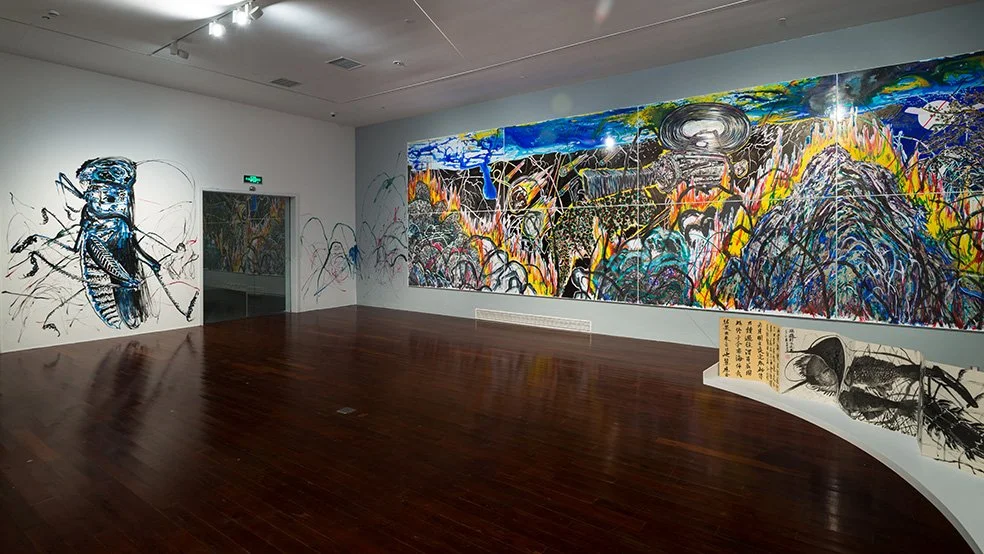
Installation View at Yuz Museum, Shanghai
In Sun Xun’s world, a magician can pull a giant mosquito from his top hat, setting it loose to suck the blood out of the world. There the insect rides triumphantly atop a globe; we spot the map of China, but clearly this could be happening in any imaginary country at any time. So powerful is this image that Sun Xun has turned it into a logo, an emblem, a symbol on a flag waving vigorously against a cloud-filled sky. It shows up repeatedly in the artist’s films and animations, in his drawings and installations. What does it mean? Who does it represent? These are questions impossible to answer, yet the persistence of this picture in the artist’s oeuvre stakes out a territory that we are anxious to explore.
Welcome to Sun Xun’s Prediction Laboratory, a select space for investigation and experimentation, rather than a straightforward museum exhibition that delivers answers and conclusions. Instead of presenting a series of resolved works, Sun Xun has chosen this occasion to reconfigure the gallery space in order to raise irresolvable questions and put forth troubling hypotheses. Crows morph into megaphones and flying machines fill darkened skies. Repeatedly, volcanoes and bombs explode to cheering crowds. We pass through a film-filled tunnel where these stories bombard us from all sides. Finally, we emerge into a lighted room where we anticipate resolution. Yet, we are confronted with billboard-sized paintings with movie machines and astronauts, exposing more suppositions that need to be tested, more allegories in need of interpretation. In our desire to meet our expectations of a conventional museum experience, we may jump to conclusions about the meaning of Sun Xun’s artworks. But, he keeps us on our toes, forcing us to stay awake and never rest easy about what he is trying to say.
In many ways, this exhibition is the perfect summation for an artist who fundamentally believes that his art is indecipherable to most of his viewers. This is not because Sun Xun smugly thinks that he is smarter than his audience or that we are too stupid to understand his ideas. This is because his basic theme is the universal inability to grasp the truth and our mutual addiction to the telling of lies. To Sun Xun, history is a lie, science is a lie and art itself is the biggest lie. So, though we might expect a museum exhibition to deliver an omniscient truth on its white walls on a sunny afternoon, this artist refuses to play the role of truth-sayer. He believes that even if he wanted to and even if he was capable of doing so, somewhere in the space between believing and seeing, artist and audience, art world and outside world, the truth would get lost in the telling.
History and Influences
Given his personal history and the history of China over the past thirty years, it would seem that Sun Xun came to this conclusion through the most natural of experiences. Born in Fuxin in Liaoning Province in 1980, he grew up at a time when China was undergoing a seismic shift in perspective. His parents, factory workers, were steeped in the Communist experience, not yet affected by the possibilities of Deng Xiaoping’s new market economy. At school where the history lessons were still rooted in the dogma of the Cultural Revolution, Sun Xun learned one version of recent political history. But at home, after dinner, his father would share a different account, informing him about how his family suffered at hands of the Red Guards, how his grandmother was forced to wear a dunce cap in public as punishment for her privileged background. This sense of dual histories was reinforced when he moved to Hangzhou as a teenager to attend the preparatory school for the China Academy of Art. There all were infected with the entrepreneurial spirit of the Open Door Policy, in sharp contrast to the anti-bourgeois attitudes in his home town. It was clear that even in the same country during the same period of time, two different realities could be found within a span of just a few hours of travel. It was Sun Xun’s inheritance to look into this phenomenon.
Much has been made about the fact that Sun Xun’s skepticism stems from a specifically Chinese background, as if encounters with duplicitous politicians and historians could only take place in the PRC. But in fact, this young artist found inspiration in philosophy and novels by western authors. A key influence was German philosopher Martin Heidegger’s 1927 masterpiece, Being and Time, which challenges traditional methodologies for analyzing existence as inevitably tainting their conclusions through unexamined and inescapable suppositions. Aldous Huxley’s Brave New World (1932) and George Orwell’s 1984 (1949) further advanced his ideas about political agendas manipulating the truth. As these great writers make clear, all human endeavors, no matter how pure, are constructed realities and our belief in them as facts or truth, merely exercises in mass collusion. At an earlier period in history, philosophers believed that the truth was inescapable, destined to override any temporarily effective falsehood. But, by the 20th century, this very notion was thoroughly derided, replaced with a viewpoint that offered a more complicated relationship between fact and fiction.
Sun Xun claims other influences as well, befitting an artist as multifaceted as him. He has often stated that the original Renaissance man, Leonardo da Vinci, is his primary inspiration which makes sense when we think how Sun Xun has a practice that ranges from ink painting, charcoal drawing, printmaking, hand-drawn animation, 3-d filmmaking, installation, even sculpture. His studio in the Heiqiao neighborhood of Beijing is a two-story factory where up to 30 assistants are employed by his company, π Animation. There in his study, his varied interests are reflected, ranging from many volumes of books in Chinese and English on history and political science to museum-quality prints on the wall by Song Dynasty artists Cui Bai (1050-1080) and Fan Kuan (990-1020). Tellingly, Sun Xun rejects the influence of such obvious animation enterprises as Japanese anime or Disney studios. Instead, he fuses Eastern and western influences so thoroughly that several American critics compare his work to artists Raymond Pettibon and R. Crumb while noting that the spirit in his work dates back to the prints of Albrecht Durer, Honoré-Victorin Daumier and William Hogarth.
But a primary influence that cannot be ignored is South African artist William Kentridge who also inventively used the tedious process of hand-drawing frame by frame to create evocative and highly romantic animations against a backdrop of political tensions. While some have said that Sun Xun came up with the idea of using this technique after seeing Kentridge’s work included in the 2000 Shanghai Biennial, Sun denies this level of direction. He in fact thought of creating animations as early as high school, some years before that, drawing out rudimentary story boards before he even had access to the cameras and equipment which would make realization possible. Though he ostensibly majored in printmaking at the China Academy, which he entered in 2001, he spent most of his time there making animations, already recruiting a team to help him achieve his vision. But he does credit Kentridge with giving him a broader idea of what animation could do, namely, create an entire body of work that builds up to an all-encompassing world view. From this insight, Sun Xun realized that he was never working on a single individual art work. Each work was a brick in an overall structure. According to the artist, one thing that makes his work so difficult to interpret is that until the structure is complete, no individual work can reveal its meaning. And of course, this structure will never be complete, as long as Sun Xun keeps making more than one film a year as he has done for the past 12 years.
Reviews
Prediction Laboratory, Kiang Malinque Magazine, 2016
From the wreckage of China’s industrial northeast, artist Sun Xun builds raft of memories to carry us to the future, South China Morning Post, 2016
Sun Xun Tears of Chiwen, E-flux, 2017
Sun Xun, Kiang Malinque Gallery, e- catalogue, 2017
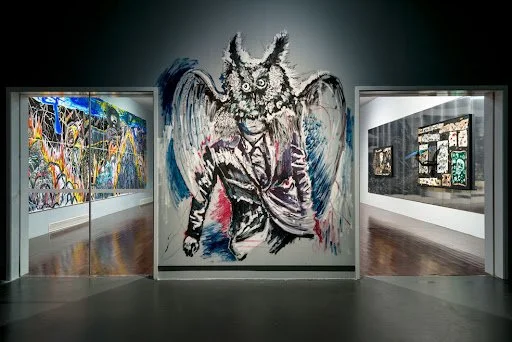
Entrance to Prediction Laboratory, Yuz Museum