Lu Yang: Doku
Jane Lombard Gallery
May 7 - June 19, 2021
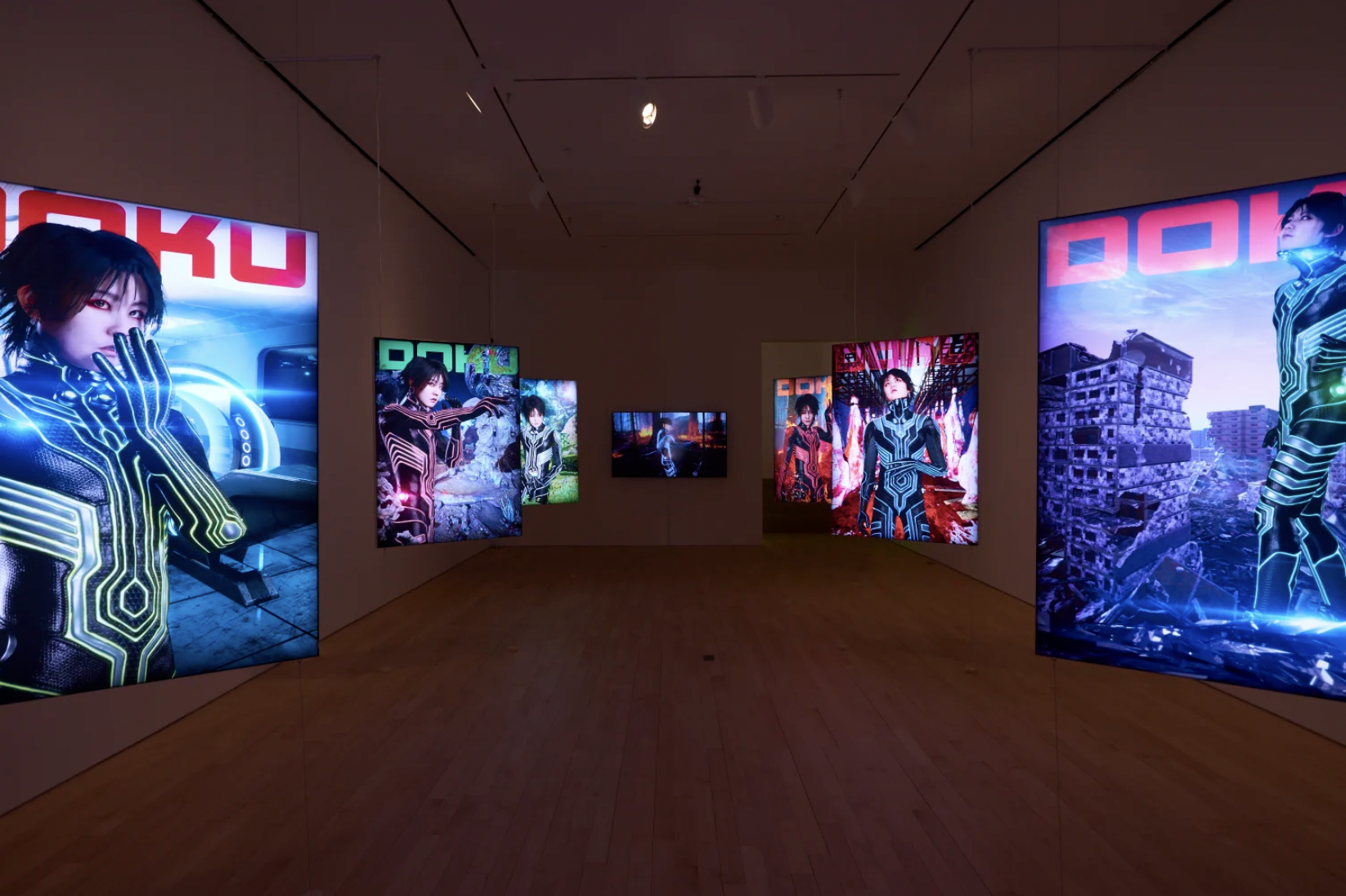
DOKU, Digital Alaya installation at Jane Lombard Gallery
Jane Lombard Gallery is pleased to present Doku: Digital Alaya, the first New York solo gallery exhibition of Lu Yang, a rising star in the global art world. Lu Yang is at the forefront of the generation of artists from China, born in the 1980s whose lives paralleled the growth of a global economy. In Lu Yang’s world, cultures collide, the digital realm prevails, and religions must be reinterpreted. These artworks--packed with avatars, while grounded in the latest scientific inquiries—are wildly engaging and often disturbing, creating post-human life forms in a world dominated by Japanese anime and interactive video games.
Doku: Digital Alaya combines ancient Buddhist ideas about reincarnation with the latest technology of motion capture and live animation. Doku is Lu Yang’s latest nonbinary avatar named after the phrase, “Dokusho Dokushi”, meaning “We are born alone, and we die alone.” Digital Alaya, the title of this show, is a reference to ālayavijñāna, the term for a storehouse of consciousness that is the basis of all mental, spiritual, and physical development. In the course of the exhibition, Doku appears in six 3-D environments, each representing one of the six realms of rebirth in a Buddhist concept of reincarnation.
The central question is whether our lives in the digital realm—made so acutely apparent during the pandemic—have undermined or replaced ancient religious ideologies. Lu Yang bypasses meditation or more conventional means of improving karma and goes directly to the assistance of scientists and technicians to find new ways to keep the cycle of life going in cyberspace.
To create a life-like digital post-human, Lu Yang collaborates with a team of scientists, 3D animators and digital technicians using motion capture, detailing the features of her face and facial expressions so that the avatar, Doku, looks remarkably like its creator. Body movements are also generated through motion capture of dancers and musicians, providing Doku with a perfect androgynous body. The artist is reborn repeatedly as a nonbinary, androgynous, ever-present avatar, capable of talents beyond physical limitations. Doku appears in six different settings that Lu Yang creates herself using 3D digital techniques. The resulting work is displayed on lightboxes, videos, and installations. The video, Doku: Digital Reincarnation takes viewers behind-the-scenes to see a process straight out of sci-fiction, as fascinating as the final works themselves.
Reviews of Lu Yang: Doku
Lu Yang Imagines Reincarnation in a Virtual World, Ocula, 2021
5 Art Gallery Shows to See Right Now, The New York Times, 2021
‘Doku: Digital Alaya’ Appears in First NY Gallery Exhibit, Vale Magazine, May 2021
Multimedia Artist Lu Yang Creates Art for Our Times, Observer, 2021
About the Artist
Lu Yang (b.1984) is a Shanghai-based artist who creates work exploring themes and formats that combine traditional Chinese medicine and spirituality together with contemporary digital cultures. Through the medium of video, installation and performance, Lu Yang explore the fluidity of gender representation through 3D animated works inspired by Japanese manga and gaming subcultures. With a fascination with the human body and neurology, Lu Yang’s work bridges the scientific and the technological with aesthetics drawn from popular youth culture creating new visions of China in the face of modernity.
Lu Yang graduated with a BA and MA from the New Media Art department of the China Academy of Art, Hangzhou. She often collaborates with performers, designers, illustrators and composers. Her work has been featured in exhibitions internationally including solo exhibitions, Electromagnetic Brainology, Spiral, Tokyo, Japan; Lu Yang: Encephalon Heaven, M WOODS, Beijing, 2017; Delusional Mandala, abc gallery night, Société, Berlin, 2016; Delusional Mandala, Beijing Commune, 2016; and KIMO KAWA CANCER BABY, Rén Space, Shanghai, 2014. Her work has been featured in major group exhibitions at the UCCA, Beijing; Centre Pompidou, Paris; 56th Venice Biennale 2015 China Pavillion; 3rd Istanbul Design Biennial; Liverpool Biennial 2016; Shanghai Biennale 2012; Montreal International Digital Art Biennial 2016; Musée d’art contemporain of Lyon; Momentum, Berlin; Tampa Museum of Art; and The 5th Fukuoka Asian Art Triennale.